
1 – Who do you really consider family?
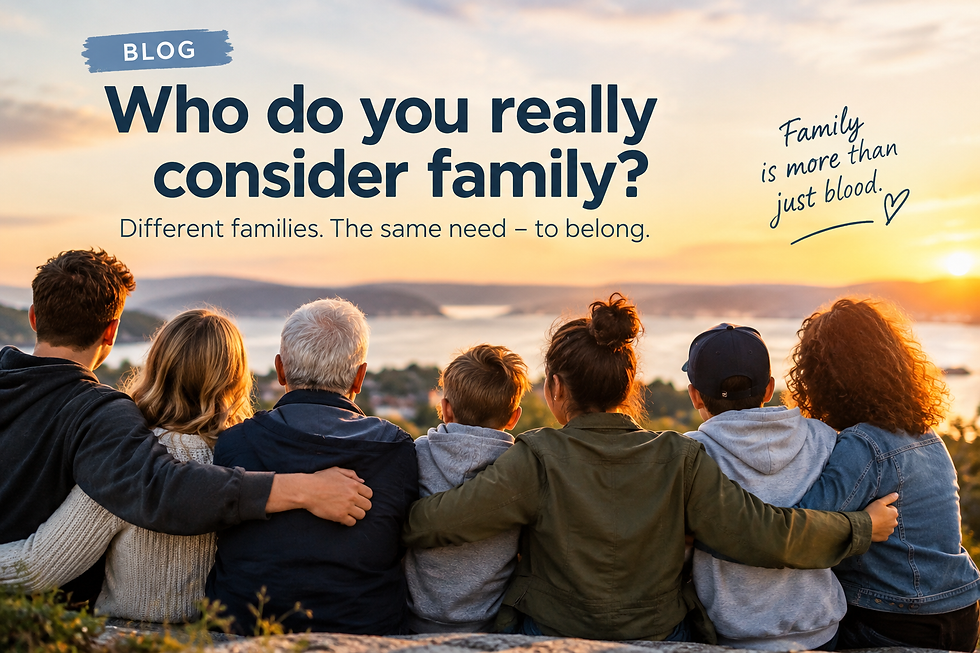
When we hear the word "family," most people think of people we are related to. Parents, children, siblings, grandparents, aunts, uncles, and maybe a few more.
But family can be much more than blood ties.
For some, family is primarily the people they love and feel safe with. For others, family is the extended family, with grandparents, cousins, and other relatives close by. And for some, family is primarily parents and children.
None of these ways of looking at family are necessarily wrong. They are just different.
The open family
In an open or inclusive family, it is not necessarily blood ties that determine who belongs.
It could be a close friend, a neighbor, a former colleague, or other people who have become an important part of your life over time. You may simply feel, “This person is family to me.”
Here, belonging is largely about trust, care and shared experiences.
Such a family may have a large network around them. When someone needs help, there may be many people to ask.
But a large open family can also be demanding. When many people have opinions, needs, and expectations, it can sometimes become unclear who is actually responsible for what.
Extended family
In the extended family, the lineage is stronger.
Here, parents, children, siblings, grandparents, aunts, uncles and other relatives can have an important place. There can be a strong expectation that the family will stand up for each other.
You might help your parents when they get older. Grandparents help with childcare. Siblings support each other when life gets tough.
It can provide a strong sense of security and belonging.
At the same time, it can also lead to expectations. When the family is closely connected, it can be more difficult to say no or choose a different path than the rest of the family.
Nuclear family
In the nuclear family, the boundaries are clearer.
The family primarily consists of parents and children, while the rest of the family often has a more peripheral role.
This fits well with a society where we place great emphasis on independence and privacy. The family decides more about how it wants to live, and resources are spent primarily on the people who live together.
The advantage can be great freedom and clear boundaries.
The disadvantage is that the family may be more alone if something difficult happens.
So which family is best?
Perhaps the most important question is not which model is "right."
The question is rather:
Who is there when you need them?
Family is not just about who is in the family tree. It's also about who shows up, who you can trust, and who you feel at home with.
For some, the answer is the family they were born into.
For others, it is the family they have chosen themselves.
And for many, it's a combination.


Comments