
Part 4: Bridge building – this is how we talk to each other without falling into the trap.
Period or not period?
👍 or 😊?
Text message or phone call?
Email or chat?
Direct message or praise sandwich?
After three blogs about generational gaps in communication, you may be left with one thought:
"How are we actually going to be able to talk to each other?"
Fortunately, the solution is simpler than we think.
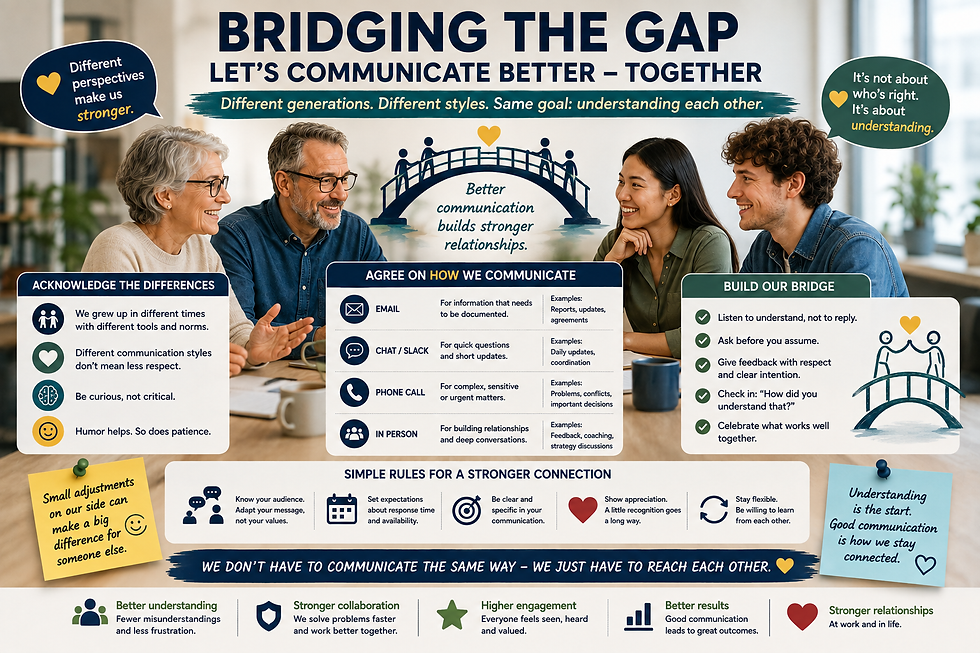
We don't need to communicate in the same way.
We just need to understand that we don't .
The first step is to stop interpreting differences as bad intentions.
A short message doesn't necessarily mean someone is upset.
A phone call doesn't necessarily mean someone is trying to control you.
Direct feedback doesn't necessarily mean you did a bad job.
And a smiley face doesn't necessarily mean everything is wonderful.
We must learn to distinguish between style and intention .
In the workplace, this can be done quite easily. Create some common ground rules:
When do we use the telephone?
When do we use chat?
What should be sent by email?
What is considered an emergency?
How do we want to give and receive feedback?
The same can be done at home.
For example, the family can agree that important things are discussed verbally, while practical messages can be sent via text message.
This way we don't have to waste energy getting irritated by each other's communication habits.
Another important step is to ask.
"How did you perceive what I wrote?"
"Would you rather I call or text?"
"Do you want direct feedback, or would you like us to talk about it a little first?"
Such questions may seem simple, but they show respect.
And maybe we also need a little humor.
The person who uses 👍 doesn't have to be cold-hearted.
Anyone who uses five emojis doesn't have to be frivolous.
Anyone who calls without sending an SMS first doesn't have to be old-fashioned.
And those who prefer messaging don't have to be antisocial.
We are humans who have learned to communicate in different times.
Boomers, Gen X, millennials, Gen Z, and the generations that come after us have grown up with different technologies, norms, and expectations, which affect how we express ourselves.
But differences don't have to create distance.
They can actually make communication better – if we become curious about each other.
So perhaps the solution is not for one generation to learn to communicate like another.
Maybe the solution is that we all learn a little of each other's language.
Because good communication is ultimately not about periods, emojis, phones or chat.
It's about being understood – and about making an effort to understand the other person.
That is perhaps the most important communication rule of all.


Comments